

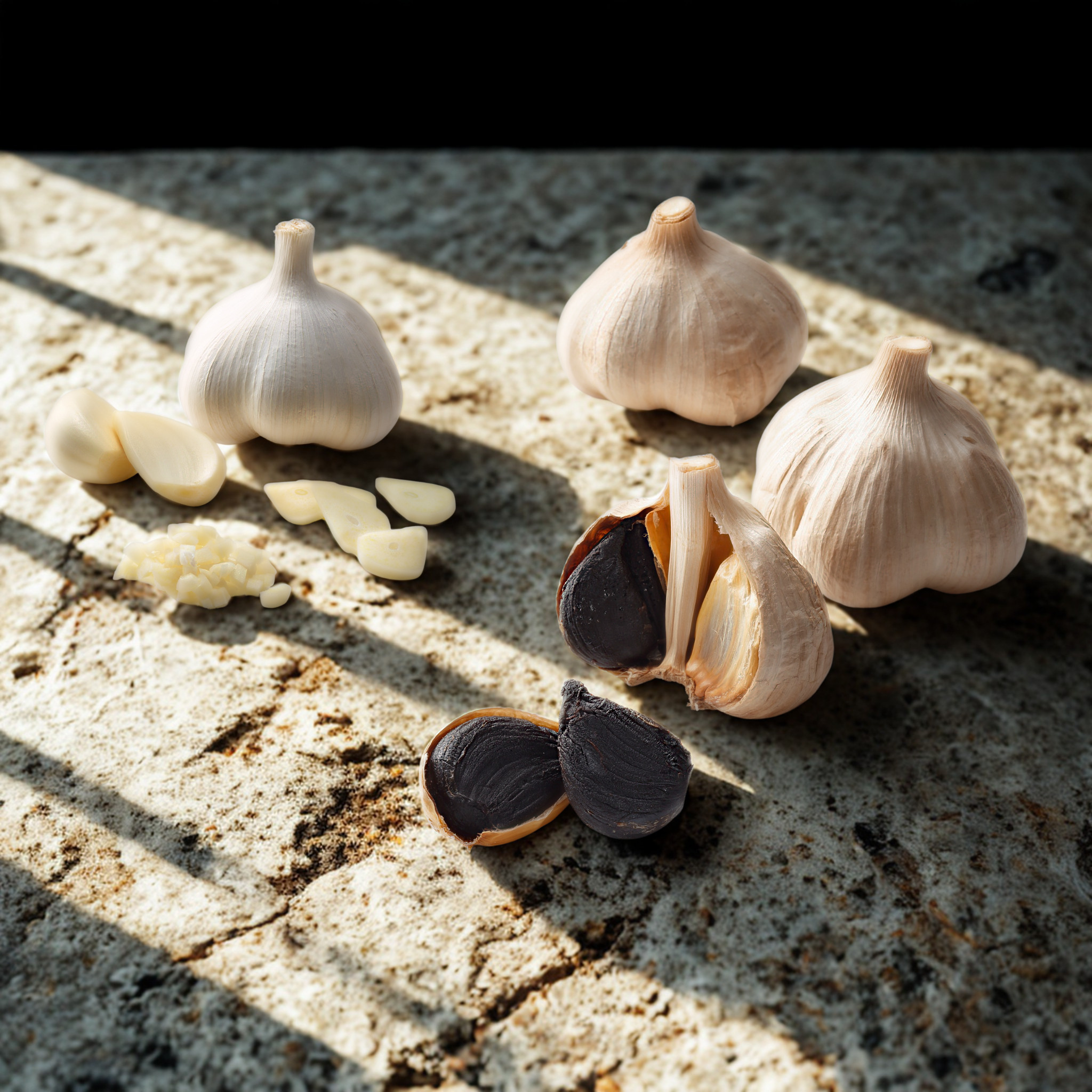
They are sometimes confused, often opposed. Yet black garlic and regular garlic come from the same bulb, grown in the same terroirs. What sets them apart is not the botanical variety, but what is done to it after harvest. The slow fermentation that black garlic undergoes to become what it is deeply changes its structure, composition and taste profile. Comparing the two means understanding two fundamentally different ingredients that do not have the same uses or the same strengths.
Origin and production: the starting point
Regular garlic is harvested and eaten as is, fresh or dried. Its composition remains that of garlic in its natural state: water, carbohydrates, sulphur compounds including allicin, and a range of micronutrients. It is a raw, powerful ingredient whose properties are directly linked to its freshness.
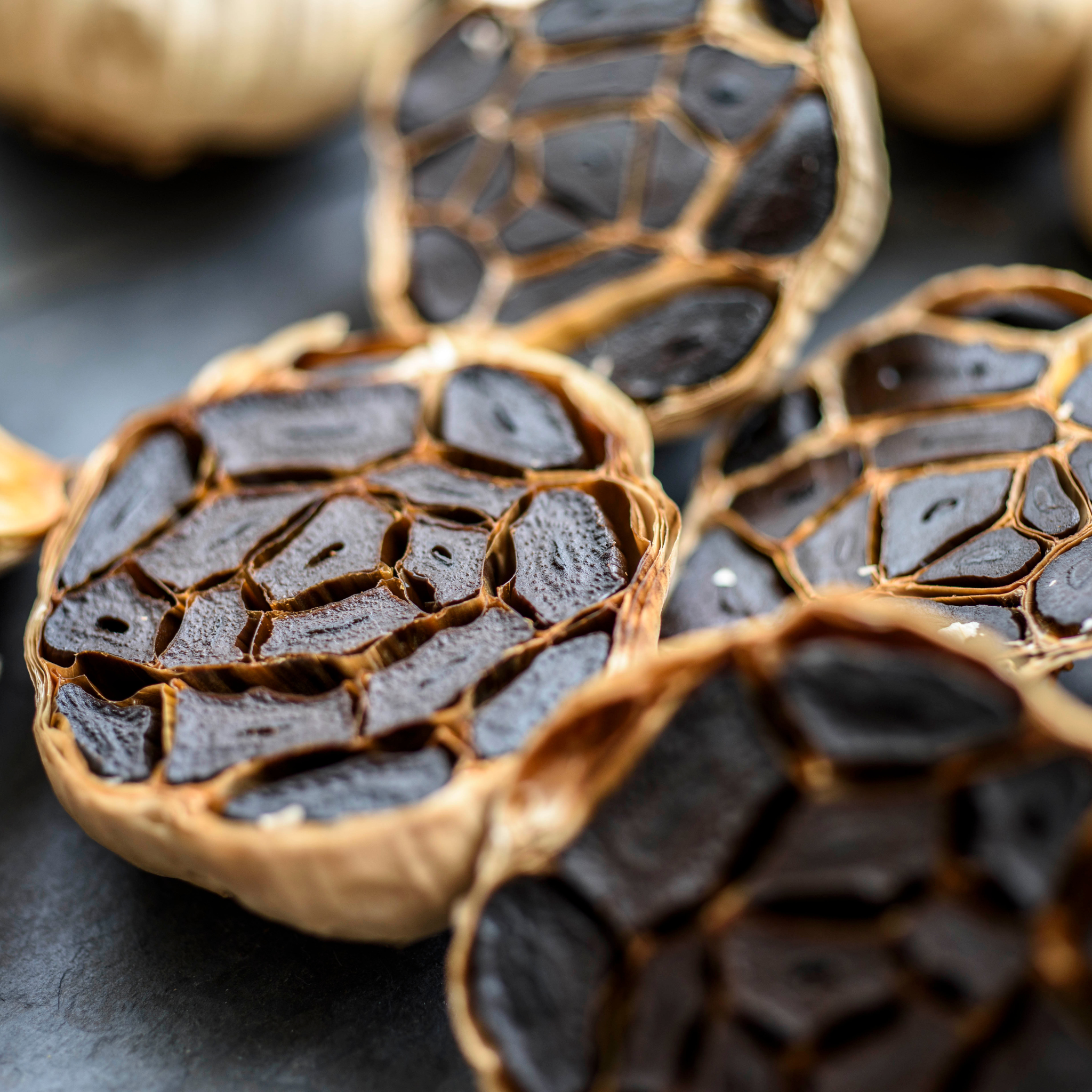
Black garlic comes from the same bulb, but goes through a controlled fermentation process at a temperature between 60 and 80 °C for three to six weeks depending on the producer. It is neither cooking in the strict sense nor a classic bacterial fermentation: it is an enzymatic and thermal reaction that radically transforms the material. The result is a new product, with its own nutritional, aromatic and textural characteristics.
Taste: two profiles beyond comparison
It is on the taste side that the difference is most striking and most immediate.
Regular garlic is pungent, sharp, sometimes aggressive. Its taste is direct, recognizable among all. Raw, it leaves a strong persistence on the palate and a characteristic smell on the breath. Cooked, it softens, becomes more melded, but keeps a very present aromatic signature.
Black garlic has almost nothing in common. Its flavour is soft, deep, lightly sweet. You perceive notes of balsamic vinegar, molasses, tamarind, sometimes prune or liquorice. It is neither pungent nor acidic. It leaves no lingering smell on the breath, which makes it a much more sociable and versatile ingredient in the kitchen.
For the uninitiated palate, the first taste of black garlic is often unsettling: you look for the garlic, and you find something unexpected, more complex and more refined.
Texture: from crunchy to melting
Fresh garlic is firm, crunchy under the tooth, slightly moist inside. Its texture is that of a dense raw vegetable, which resists then releases into an aromatic juice.
Black garlic has a radically opposite texture. Fermentation breaks down the cell walls and transforms the sugars, giving rise to a supple, soft, almost confit clove. It crushes effortlessly between your fingers, spreads on a slice of bread, blends instantly into a sauce or a purée. Some compare it to a melting caramel or a very ripe olive confit in oil.
This texture is one of the first criteria that appeals to cooks: it simplifies the incorporation of garlic into preparations and removes the need to chop or mince.
Nutrition: which is more valuable?
Both forms of garlic have real nutritional strengths, but they are not identical.
Regular garlic is rich in allicin, the sulphur compound released when the clove is cut or crushed. It is to allicin that the antimicrobial, antifungal and cardiovascular properties traditionally associated with garlic are attributed. It is, however, volatile and partly destroyed by cooking.
During fermentation, allicin transforms into more stable organosulphur compounds, notably S-allylcysteine. This derivative is better absorbed by the body, less irritating to the stomach, and has a higher bioavailability. Several studies have shown an antioxidant concentration in black garlic between five and ten times higher than in raw garlic, with better heat resistance.
Black garlic also contains more natural sugars (which explains its softer taste), but its calorie content remains modest. Its digestive tolerance is clearly better than that of raw garlic, which makes it an interesting option for people sensitive to fermentable foods.
In short: regular garlic is more powerful raw, but black garlic offers more stable compounds, better absorbed and more concentrated in antioxidants.
Use in cooking: two different logics
Regular garlic is a base, foundation and starting ingredient. You sauté it at the beginning of cooking to launch a sofrito, a sauce, a simmered dish. It flavours the oil, colours the juices, structures the flavours.
Black garlic is an ingredient of finishing and complexity. You add it during or at the end of cooking, you stir it cold into a vinaigrette or a compound butter, you place it on a tasting board. It is not designed to launch a dish but to deepen it.
The two can coexist in the same recipe: regular garlic to build the aromatic base, black garlic to bring the finishing touch. It is a logic of complementarity more than of substitution.
How to choose between the two
The choice between black garlic and regular garlic depends essentially on the use and the profile you are looking for.
If you are cooking a traditional dish that relies on the power of garlic, such as an aioli, a garlic soup or an old-fashioned roast lamb, regular garlic remains irreplaceable. Its strength is precisely what you are looking for.
If you want to add depth to a dish without altering its balance, if you are looking for an ingredient that works as well raw as cooked, that you can add without any particular technique, and that is easy on digestion, black garlic is the obvious choice.
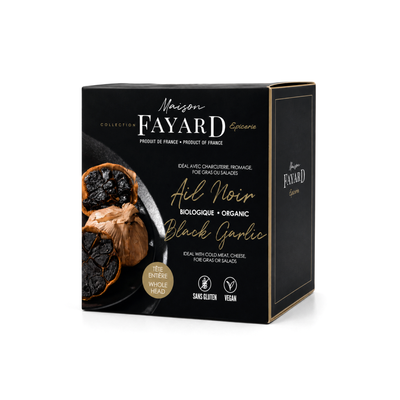
For those starting out with black garlic, the selection offered at Maison Fayard provides products with well-mastered fermentation, where softness and aromatic complexity are there from the very first tasting. It is an ideal gateway to discover this ingredient with no risk.
FAQ
Is black garlic stronger than regular garlic?
No, it is the opposite. Black garlic is much softer than regular garlic. Fermentation removes the characteristic pungency of fresh garlic and replaces it with sweet, balsamic aromas, with no aggressiveness on the palate.
Can black garlic be used as a direct substitute for regular garlic?
Partly. Black garlic can replace regular garlic in most cooked dishes, but the result will be softer and more complex. In recipes where the power of raw garlic is essential, it is better to keep regular garlic or combine the two.
Is black garlic healthier than regular garlic?
Both have distinct strengths. Black garlic contains more concentrated antioxidants and compounds better absorbed by the body. Regular garlic keeps a higher allicin content when raw. Ideally, both have a place in a varied diet.
Is black garlic suitable for people intolerant to ordinary garlic?
Often, yes. Fermentation makes black garlic much more digestible than raw or even cooked garlic. People sensitive to fermentable foods generally report much better tolerance to black garlic. In case of doubt, it is advised to start with small amounts.